
Trainer Levels
Martial Arts Association – International (MAA)
The Martial Arts Association – International understands martial arts as a way of personal, social and holistic development.
Martial arts serve not only for physical training, but also for the promotion of self-awareness, responsibility, respect and inner stability.
The MAA is open-to-style and brings together a wide variety of martial art forms based on common values and principles.
The focus is always on the person – regardless of age, origin, level of performance or style.
Teaching, pedagogy and therapeutic accompaniment take place responsibly, ethically reflected and within clear professional boundaries.
The MAA promotes quality, personal maturity and continuous development of its members and instructors.
Core ideas of the MAA
- Style diversity instead of style boundaries
- Principles instead of collections of technology
- Responsibility Instead of Power
Development instead of comparison
Overall Logic of Training (MAA)
- Instructors: Security and support
- Trainers: Structure and Methodology
- Teachers: Principles and Personality
- Educators: Development and Responsibility
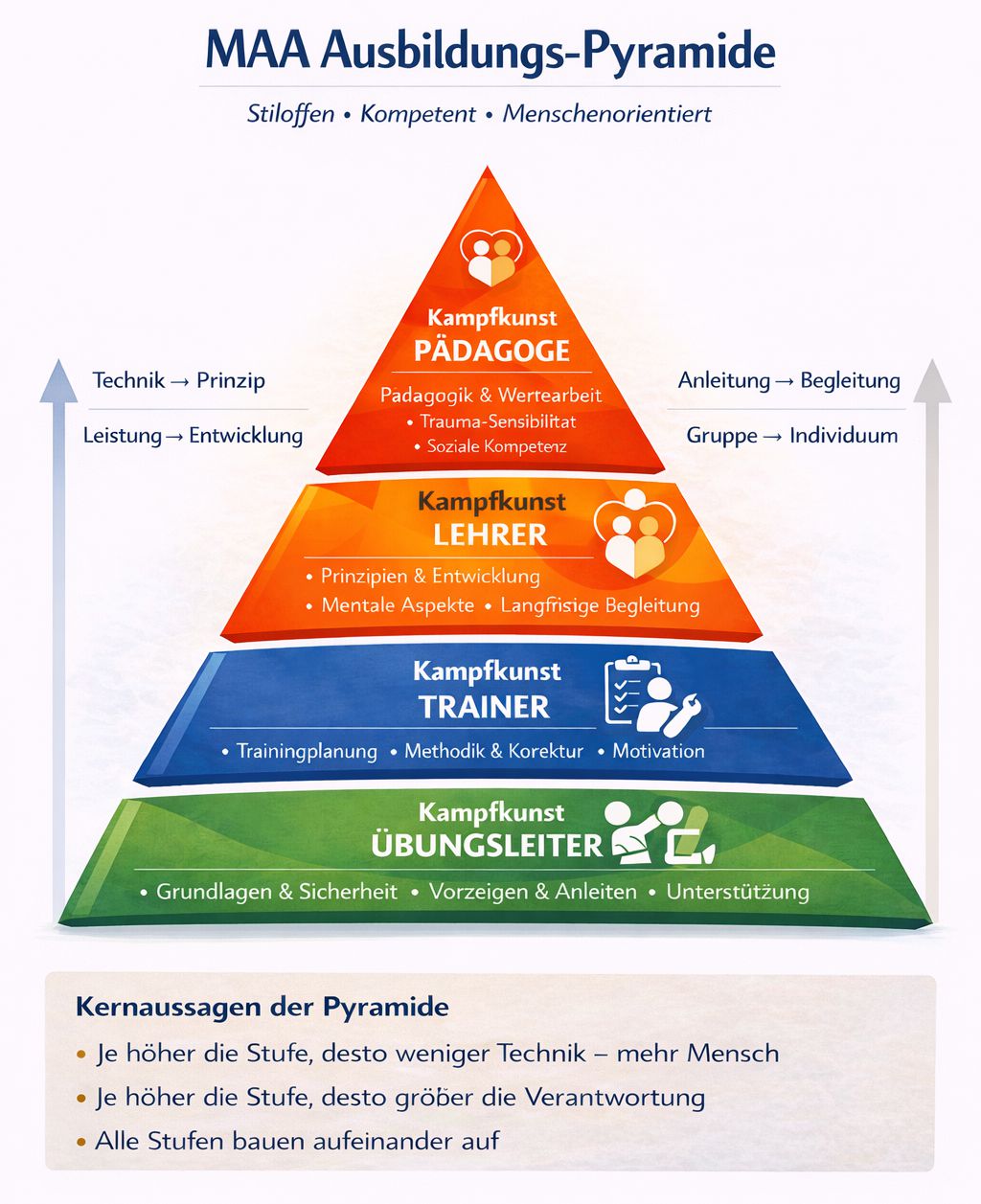
The higher the level, the more the focus shifts:
- from Movement → Development → Accompaniment → Support → Healing
- from Technology → Principle → People

In addition to the four major coach levels, we have further sub-levels for each level in order to enable the appropriate levels depending on requirements / discipline / club and club structure.
MAA Code of Conduct for Trainers
Self-understanding
MAA coaches accompany people responsibly.
Their actions serve the development, safety, dignity and strengthening of trainees. Ethics is the basis of all actions.
- Responsibility and example
Trainers act consciously, respectfully and in a controlled manner.
They do not use their role for ego, power or self-expression.
- Security and protection
Physical and mental integrity is a top priority. Training is age-appropriate, development-appropriate and situation-appropriate. Dangerous behavior is consistently prevented.
- Professional & Quality
Coaches only teach what they can answer for.
They reflect their actions, educate themselves and know their limits.
- Respect and dignity
There is no room for humiliation, degradation and abuse; criticism is factual and constructive.
- Pedagogical attitude
Training promotes self-employment, self-confidence and responsibility. Development is about performance.
Individual learning paths are supported.
- Boundaries and Integrity
Professional boundaries are maintained.
Dependencies are not exploited.
Private or economic interests do not affect the training.
- Violence
Martial arts serve self-control and protection, not aggression.
Violence is reflected, not glorified.
Self-defense means responsibility, not retribution.
- Power and authority
With skill, responsibility grows.
Authority arises through attitude and example, not through coercion.
- Child and youth training
Children and young people enjoy special protection.
Relationships are clear, transparent and professional.
Physical contact is functional, explained and limited.
Language is respectful and age-appropriate.
Trainers work closely and openly with parents.
- Social responsibility
The MAA rejects extremism, abuse and ideological appropriation. Martial arts are designed to connect, stabilize and promote responsibility.


Training plan
In addition to the respective martial arts discipline technical teaching program, we have designed an online teaching program for each trainer level, where the further theory-related teaching content on the respective trainer level is taught.

Martial Arts Training Manager (MAA) Training Plan
Training objective
The instructor is capable of training Safe to support and Basic exercise units to guide.
Module 1: Basics of Martial Arts
- Role and responsibility of the instructor
- Basic understanding of martial arts as a development path
- Dojo/training etiquette, values and attitude
Module 2: Basics of Movement
- General movement theory
- Coordination, stability, mobility
- Basic Body Mechanics
Module 3: Safety and Prevention
- Heat-up and heat-down
- Injury prevention
- Detection of overload
- Safe training environment
Module 4: Instructions & Showcases
- Clear demonstration of movements
- Simple verbal instructions
- Structure of a training section
Module 5: Group support
- Order and Attention in Groups
- Dealing with Beginners
- Supportive coaching role
Practice share
- Assistance in regular training
- Guidance of partial sequences
- Observation and feedback
Martial Arts Trainer (MAA) Training Plan
Training objective
The coach is capable of training independently plan, implement and adapt.
Module 1: Training teaching
- Load control
- Strength, endurance, speed, mobility
- Training structure and structure
Module 2: Methodology & Didactics
- From the simple to the complex
- Learning styles and forms of mediation
- Fault detection and correction
Module 3: Training planning
- Short- and medium-term planning
- Objective definition
- Documentation of training units
Module 4: Communication & Motivation
- Clear language and presence
- Motivation without pressure
- Dealing with different levels of performance
Module 5: Responsibility and role
- Exemplary function
- Limitations of the coaching role
- Dealing with conflicts in training
Practice share
- Independent management of training units
- Preparation of training plans
- Reflection of your own teaching
Martial Arts Teacher (MAA) Training Plan
Training objective
Teacher teaches martial arts Holistic and accompanying people long-term development.
Module 1: Principles of Martial Arts
- Principles of movement and action
- Transferability to different situations
- Technology as an Expression of Principles
Module 2: Mental and Inner Work
- Concentration and perception
- Dealing with Stress and Pressure
- Self-reflection and mindfulness
Module 3: Foundations of Education
- Learning in adults and adolescents
- Individual support
- Responsibility in the Teacher Role
Module 4: Personal Development
- Martial Arts as a Development Path
- Value transfer
- Authenticity and attitude
Module 5: Long-term support
- Development over years
- Mentorship
- Reflection of learning processes
Practice share
- Care of students over a longer period of time
- Analysis of individual development pathways
- Teaching demonstrations
Martial Arts Educators (MAA) Training Plan
Training objective
The teacher uses martial arts targeted as an educational tool for personal and social development.
Module 1: Pedagogical self-understanding
- Role of the educator
- Differentiation between coaches and teachers
- Responsibility in dealing with people
Module 2: Developmental Psychology
- Children, adolescents and adults development
- Emotional and social phases of development
- Understanding behavior instead of evaluating it
Module 3: Values & Relationship Work
- Respect, self-control, responsibility
- Relationship design
- Setting limits without exercising power
Module 4: Prevention & Conflict Work
- Violence prevention
- Conflict resolution
- Promotion of social skills
Module 5: Trauma Sensitivity (non-therapeutic)
- Recognizing stress and overwhelming responses
- Secure, stable framework
- Knowledge of own boundaries and referral
Practice share
- Pedagogical project (e.g. school, youth group, association)
- Documentation and reflection
- Presentation of pedagogical work