
Sword of Freedom Corps
The Sword of Freedom – Corps (SOF-Corps)
Department of the Flame of Peace – Association for the Promotion of Peace e.V.
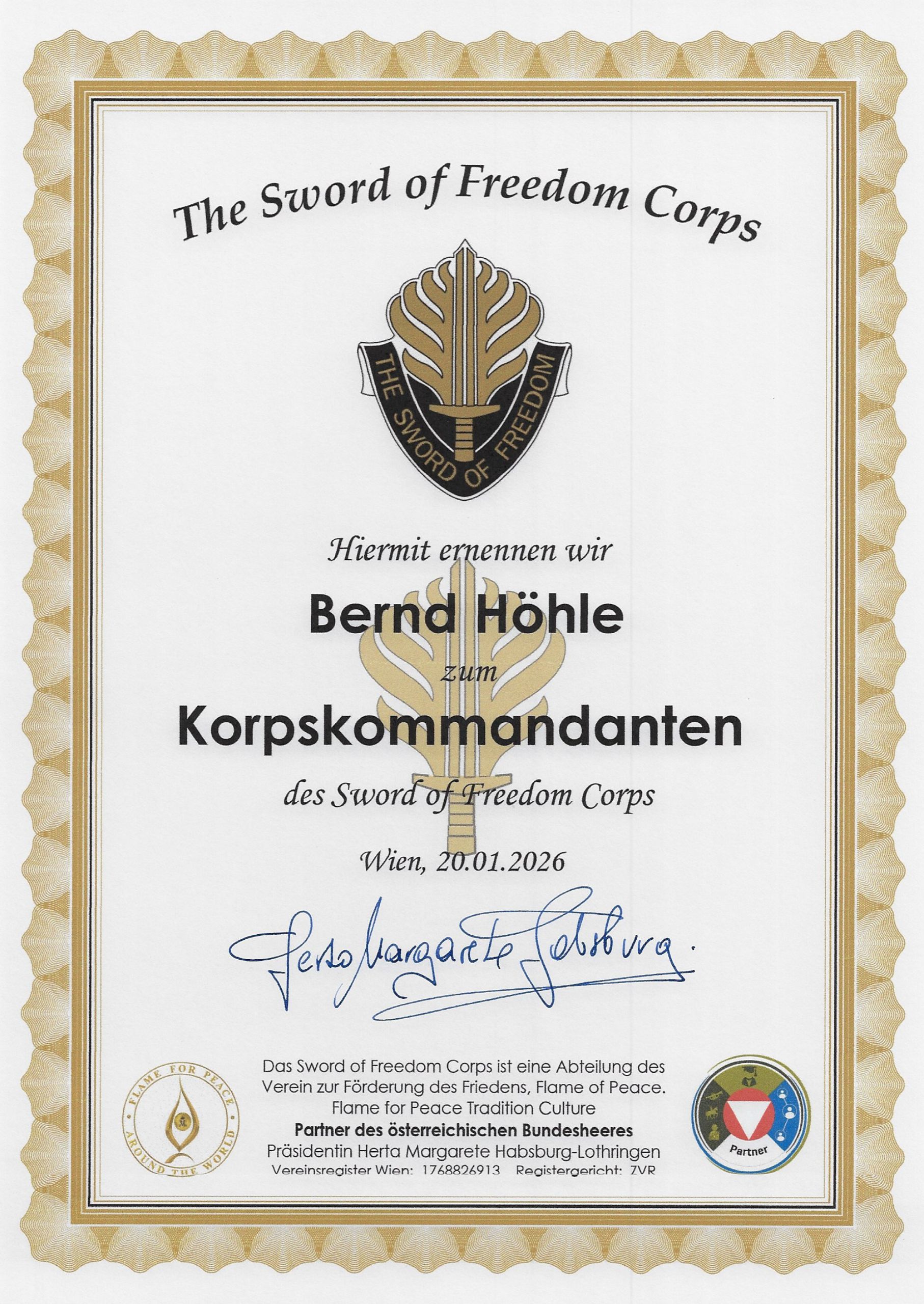
The Sword of Freedom – Corps (SOF-Corps) is an internationally active, operational department of the association “Flamme des Friedens – Verein zur Förderung des Friedens e.V.” (Flamme of Peace Tradition & Culture)”, an organization that works worldwide for peace, humanity, social justice, cultural understanding and sustainable development. The Association for the Promotion of Peace e.V. is an official partner of the Austrian Armed Forces. Within this structure, the SOF-Corps acts as a practice-oriented deployment and project platform that converts ideal goals into concrete measures. While the umbrella association primarily promotes representative, diplomatic and cultural initiatives, the SOF-Corps assumes the role of an effective unit for humanitarian, social, educational and security-relevant tasks.
The guiding principle “We are for others and no one alone” It describes both internal solidarity within the organisation and global responsibility towards people in emergencies. The aim is not only short-term help, but sustainable support that strengthens independence, dignity and social participation.
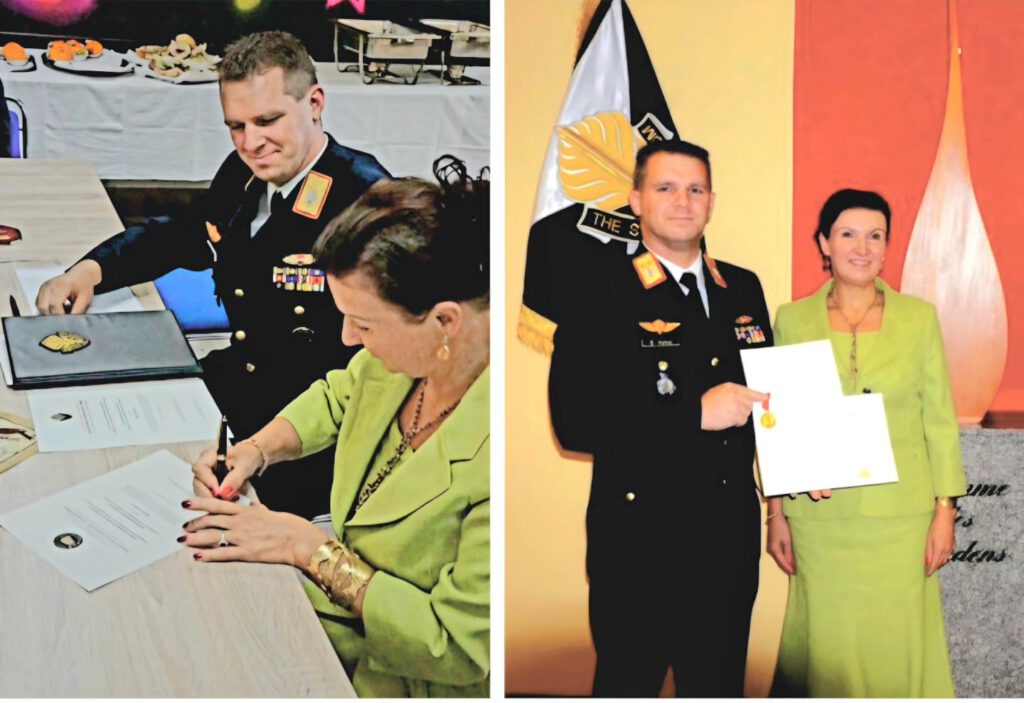
Herta Margarete Habsburg-Lorraine’s assumption of patronage in 2013 was of particular importance for the development and public perception of the organisation. As President of the Flamme des Friedens – Verein zur Förderung des Friedens e.V. and patron of the Austrian Armed Forces, she has since lent an additional symbolic and representative force to the humanitarian and peace-promoting efforts of the association and the SOF Corps. Her support underlines the organisation’s international aspirations and at the same time strengthens its commitment to understanding, cultural dialogue and sustainable peace work.
International integration and recognition
The international networking of the SOF Corps is particularly evident in the cooperation with the Lazarus Union Austria, a global aid and peace organisation. This cooperation is linked to the United Nations Department of Economic and Social Affairs (UN-ECOSOC), where partner structures are registered. This involvement enables participation in international programmes, conferences and projects in the field of sustainable development, civil protection and peace work. The repeated nomination of the Lazarus Union for the Nobel Peace Prize underlines the international recognition of the work done, which also benefits the SOF Corps as an operational partner structure. It strengthens visibility, credibility and cooperation opportunities at global level.
Furthermore, the SOF-Corps/MAA cooperates closely with the Kinderhilfswerk International Children Help e.V., This cooperation supports and jointly implements projects in the areas of education, medical care, food security and emergency humanitarian aid. Through this partnership, the SOF Corps extends its scope to include targeted measures for children and families in crisis and development regions. At the same time, the cooperation strengthens the international networking of the organisation and contributes significantly to its global recognition as a reliable partner in humanitarian aid.
Structure and organisational principle
The SOF Corps is active in different parts of the world, because of its members, and follows a deliberately decentralized organizational model, with national and regional sections working independently, but guided by common guidelines, ethical principles and quality standards.
- Rapid response capability in crisis situations
- Adaptation to local cultural and social conditions
- efficient use of regional resources
- Continuous knowledge transfer within the network
The organisation is explicitly non-political, neutral and non-denominational, and all projects are geared exclusively to the needs of the people concerned.
Value base and guiding principles
The work of the SOF Corps is based on three fundamental pillars:
Willingness to help — Respect — Tolerance
Every human being, regardless of background, religion, gender, worldview or social status, is considered to be of equal value, resulting in a humanistic attitude that sees aid not as charity but as a responsibility of solidarity, a special feature of which is the predominantly voluntary structure, many missions, travel and materials are financed from private funds, and this form of self-responsibility strengthens intrinsic motivation, credibility and independence.
Membership structure and competence profile
The members of the SOF Corps come from different professional and social sectors, including:
- Rescue and security services
- Civil protection
- Social and educational work
- Medical professions
- Martial arts
- Pedagogy and youth work
- Engaged citizens
This interdisciplinary composition enables an exceptionally broad competence base. Experience from professional operational structures is combined with pedagogical know-how and sporting methodology.
Humanitarian projects worldwide
Practical work covers a wide range of international relief efforts, including in Nepal, India, the Philippines, Paraguay, Thailand and various regions of Africa and Europe.
- Medical supplies and health camps
- School construction and educational projects
- Disaster relief and reconstruction
- Supply of food and clothing
- Social inclusion programmes
- Support for local initiatives
The SOF Corps is also involved in social projects in Europe, such as flood and refugee aid and support for disadvantaged population groups.
Civil protection and crisis management
Special emphasis is placed on emergency preparation and support, and through cooperation with authorities, aid organisations and local associations the SOF Corps can:
- Providing logistical support
- Mobilising volunteers
- Provide material
- Supporting evacuation and supply measures
- Implement prevention training
These skills result from the professional expertise of many members in the security and rescue sector.
Education, sport and integration
In addition to acute assistance, the SOF Corps pursues long-term social goals through education and sports programmes.
- Personal development
- Violence prevention
- Integration of people with a migration background
- Inclusion of people with disabilities
- Promotion of social skills
The main focus of sport is on martial arts and martial arts, which are not primarily understood as self-defense, but as an educational instrument for imparting discipline, responsibility and respect.
A large proportion of the members come from the Martial Arts Association – International (MAA-I). This network originally gave rise to the idea of pooling existing human and organizational resources for humanitarian purposes.
History of the SOF corps
The roots of the SOF corps lie in the martial arts community of the MAA-I. Years earlier, the idea of establishing its own auxiliary structure arose there. Through fundraisers, collecting actions and voluntary missions, an independent section gradually developed.
With the increasing number of projects and international networking, this section has been expanded into a comprehensive organisational unit, bringing together various fields of activity, including:
- Civil protection
- Civil protection
- Security service
- Charitable services
- Crisis management
- Sports and youth work
- Volunteer service
This merger led to the official designation “SOF-Corps”.
Project work and concrete measures (Selection 2020-2023)
Projects supported or implemented include:
- Assistance for Syria, Ukraine, Turkey and Georgia
- Flood relief in the Ahrtal
- Medical relief efforts in India and the Philippines
- Refugee assistance in Europe
- School and kindergarten development services
- Wheelchair and clothing donations
- Feeding programs for children
- Supply of protective masks during the COVID-19 pandemic
- Support for women’s shelters and shelters
This diversity demonstrates the organisation’s flexibility to respond to different humanitarian challenges.
Pedagogical concept and philosophy of training
A central concern is the transmission of fundamental social values to future generations:
- Humanity
- Freedom and democracy
- Responsibility
- Solidarity
- Justice
- Respect and tolerance
The pedagogical guiding principle is:
‘Learning — Learning to act’
Education and training are practical and holistic, and the human being is not considered deficit-oriented, but as a unit of physical, emotional, social and cognitive abilities.
Instructors see themselves as learning companions who promote self-employment, personal responsibility and teamwork.
Team and Personality Programs
One example is the project “Team Character Plus”, which is aimed at children, young people and professionals, including:
- Violence prevention
- Communication training
- Conflict resolution
- Leadership competencies
- Self-confidence and self-efficacy
- Mental and physical resilience
Trainers, teachers, educators and supervisors also benefit from these programs, as they receive practice-oriented methods for their professional work.
Orientation towards global development goals
The strategic orientation takes into account the Sustainable Development Goals of the United Nations (SDGs). Within the organization, corresponding concepts have been developed that show how individual sections can implement these goals in voluntary work and at work – for example in the areas of education, health, equality and poverty reduction.
The SOF Corps is a unique link between humanitarian aid, educational initiative and sports education network, and its strength lies in the combination of:
- International networking
- Volunteer engagement
- Interdisciplinary expertise
- Practical operational capability
- Value-oriented educational work
From a small idea within a martial arts federation, a globally active community has emerged that shows how committed people can bring about sustainable change through cooperation, competence and solidarity.
The SOF Corps thus exemplifies that peace is not only a political goal, but above all a practical task – realized through concrete aid, education, cooperation and lived humanity.