
Institute of Budology
“Institute of Budology” – Science, Research and Teaching
Budo is an umbrella term for martial arts, and many martial arts and martial arts have a profound history, with roots that go back without one being really aware of it. The appreciation of discipline, respect, sincerity and loyalty in these areas leaves a great fascination for everyone, with the background and knowledge of the traditions that come with it in the foreground, allowing us to incorporate the knowledge that comes from it into our daily lives.
Because the goal of the martial arts is to reconcile body and mind so that they work together optimally, for example, to be able to withstand a confrontation. A conscious presence in the present moment can thus achieve a high efficiency of one’s own actions. Intuition and technology thus enable new paths to be taken. Mental strength is just as important as mindfulness for the inner and outer action. In this way, we can better face many situations in everyday life with more serenity or openness.
Through special training, we can transfer basic martial arts principles such as focusing, using timing and centering in everyday decision-making, stress or conflict situations. Mindful observation of external events and one’s own inner consciousness allows us to see how much our ideas of reality can be influenced. Through physical and mental experiences, an in-depth understanding of stress dynamics and conflict de-escalation can be developed, and through introspection and mental exercises, sensitivity to the intricacies of human interaction is increased.

Not being put under pressure, regulating thoughts and feelings, recognizing and reducing tensions are learnable skills that promote your mental strength. For example, the basics of the teachings of Myamoto Musashi or Yagyu Munenori can be used. They serve today as an essential basis for strategy and thinking in large corporations. But also in natural life, they can lead to a more conscious being.
Our mindset, our consciousness or our actions are ultimately influenced by people we believe because of their words, and while we follow the achievements of the present and our gaze is constantly forward to constantly reinvent ourselves, many lessons from the past are ultimately a key to today’s success.
With the Institute of Budology, we see ourselves not only as a teaching and research institution with an academic character, but also as an artistic and cultural organization. It is not only the task of constant training. The knowledge and exploration of the philosophy, history and culture in Budo should also be an important component and companion. Science denotes the entirety of human knowledge taught through collection, preservation or extension.
In the future, the „Institute of Budology“ will be a trailblazer and, as a specialist department in the „Martial Arts Association – International“, will build further bridges in which the old values and traditions with the new and present clubs will be brought together. All those who have a certain knowledge in a certain field of expertise, we want to bring together. Their knowledge and skills can thus be understood as a source of knowledge in the Budo, which should be accessible to everyone in order to benefit more from each other. This applies not only to martial artists or martial athletes, but also to any individual or manager.
Bringing existing knowledge to life with a way of life and attitude to life in the “Institute of Budology”.

Institute of Budology – a living museum in the Martial Arts Association – International is emerging
The true martial artists are like time machines. They collect the figurative inventory of different cultures and epochs and, using the time categories, bring it into a relationship of succession and simultaneity, the former and later, the now and the other time. You can say: martial artists transform their knowledge from ancient times into objects of our present time. They become living documents, relics or remnants and move with their knowledge into a more or less complicated temporal order. Nevertheless, the true art is to convey this knowledge in such a way that history, tradition, philosophy and culture are in constant harmony. Because in many ways history is present today as a media event.
Historical nonfiction and novels, tourist offers, historical festivals, advertising, films, computer and video games with historical content, magazines, radio features, game documents on television – the list could be continued for a long time. It is almost an inflation of visually stunning products in which we encounter history. And access to the Internet is ubiquitous and downright popular, because it is simple and uncomplicated. So how do we as an international martial arts federation manage to establish a museum, if the young generation is still hardly enthusiastic for it today? With a museum, one is under the supposed pressure of various competing offers, whose attractiveness seems to be so much greater, at least at first glance. The museum, in particular, as a place of preservation of authentic things, of research and of exhibition, has to develop its own positions in order to be able to respond to the historical image and understanding of the history of the museum visitors.

The magic of each location
For me, as President of MAA-I, the main focus here is on the way of mediation, not so much about conveying facts and figures as about reconstructing history as life-like as possible through illustration, visualization and the creation of perspective, and this is done in different ways through media and personal mediation.
Immediately connected to the „Institut für Budologie“ of a specialist department of the MAA-I, there is a dedicated dojo, which is located directly in a children’s and youth recreation center. In the middle of forests, meadows, and many lakes, the children’s and youth recreation center KiEZ Frauensee, in the middle of the Nature Park Dahme Heideseen in Brandenburg / Germany. With targeted awareness training, an understanding of a sustainable interaction is created. In the KiEZ Frauensee itself for many years with a meaningful leisure and theme design, which is based on a demanding concept and offers corresponding educational offers (projects). As a nature-oriented extracurricular learning location, the KiEZ offers a variety of possibilities for inclusive children’s and youth encounters, teaching-supplementing knowledge and leisure activities, but also enough space for the implementation of ideas and programs of the guests. For example, in the existing martial arts school for more than fifteen years, special projects with a way of life and attitude to life are taught.
From 2004 to 2019, more than 15,000 children and young people have been able to visit this dojo directly. In an authentic and highly educational way, values, philosophy, culture and tradition from the world of the martial arts were conveyed. The facility itself has an annual influx of around 55,000 overnight visitors. The 24-hectare area, which is located directly on a forest lake, has around 800 sleeping places and is used by school classes, clubs, families, organizations and many more.
I myself have been on site several times and have been able to see for myself the valuable work of our MAA-I functionary Danny Koch. He is working in this institution as a budo, sports and experience teacher. At the same time, he runs the martial arts school and for the Institute of Budology. So which place is better designed for such a high frequency of visitors and the pedagogically valuable offer to create an MAA-I museum?! So we would like to provide a future-oriented insight into the Budo and our association, the MAA-I. This is how the idea of museum pedagogy was created. A place or rather a museum with experience character and method. For this purpose, we have put on paper many plans to bring already existing exhibits, models and historical pictures as well as documents from the world of martial arts meaningfully to the next generation through guided tours, talks or museum-pedagogical experience programs. it is often neglected to include the original museum exhibits in the mediation, e.g. to visit guided tours and to anchor the objects in their original context of use. And especially for children and adolescents as well as an adult person himself, it is a lasting experience if you can touch a samurai armor or even put on the helmet. This would make the much-cited foreignness of the exhibits, which were torn from their original context of use and presented in an artificial environment, a bit nullified.
A history culture designed in this way to experience and touch shapes people’s historical awareness more than ever. Exhibitions and museum educational experience programmes, lectures and excursions as well as the experience of the diversity of our association, the MAA-I are our goal.
Bernd Höhle
MAA-I

Honorary title of the Institute of Budology
The Institute of Budology is distinguished by the awarding of honorary titles to personalities who are distinguished by special merits in the world of Budo, which are awarded by decision of the Board of Trustees to individuals who have excelled in their extraordinary contributions and qualifications.
-
BudologistThis title is given to experts who have extensive studies, research and practical experience in the field of Budo. Budologists have a deep understanding of the various aspects of Budo, including techniques, history and philosophy. They contribute to the further development and understanding of Budo through their work and serve as a source of inspiration and knowledge for the Budo community.
-
Budo historiansThe Budo Historian’s Honorary Title is given to individuals who have excelled in their research and documentation of Budo’s history and development. These historians are dedicated to researching historical sources and preserving Budo’s rich heritage. Their work is critical to preserving knowledge of Budo’s origins, developments and cultural influences for future generations.
-
Budo philosopherThis title is given to individuals who excel in the philosophical and ethical aspects of Budo. Budo philosophers explore the moral, spiritual and life-philosophical teachings anchored in Budo. Their reflections and theoretical analysis help to understand and disseminate the deeper meaning and wisdom of Budo.
-
HatamotoThe title Hatamoto is a special award given to individuals who are considered pioneers or pioneers in the world of Budo, who have made extraordinary contributions to the development, popularization or renewal of Budo, and who are recognized for their visionary leadership, commitment and inspiration within the Budo community.
These honorary titles of the Institute of Budology are not only recognitions of individual achievements, but also symbols of the outstanding contribution of each honoree to the Budo community and to the continuous development of Budo as an art form and way of life. They reflect the diversity and depth of knowledge and commitment that exists in the world of Budo. These titles were first introduced by the Institute of Budology into the world of Budo as honorary titles.
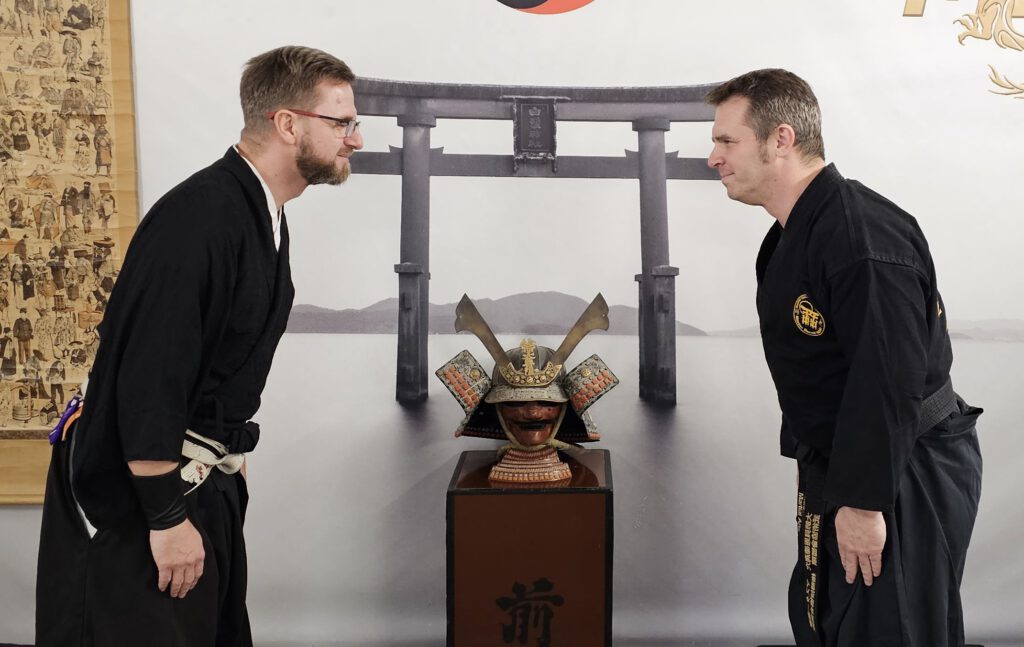
De Der Honorary title “Budologist”
The honorary title of Budo is a highly respected award given to exceptional personalities in the world of Budo. This title is given to individuals who excel in deep knowledge, extensive research and practical experience in various aspects of Budo. A Budoologist embodies the essence and depth of Budo by mastering both the physical and philosophical elements of this versatile and profound practice.
Key aspects of the title “Budologist”:
- Comprehensive expertiseBudologists have an extraordinarily broad and deep understanding of the various martial arts encapsulated by the term budo, and this knowledge encompasses not only the technical aspects and skills, but also the historical, cultural and philosophical backgrounds of these practices.
- Research and studyA Budologist is deeply involved in the research and study of Budo, including the analysis of historical texts, the study of traditional techniques, and the continuous exploration of the evolving forms and interpretations of Budo.
- Practical experience: In addition to theoretical knowledge, Budologists bring extensive practical experience, having often practiced various martial arts for years and having a deep understanding of the physical and mental aspects of training.
- Contribution to the Budo communityBudologists actively contribute to the Budo community, whether by teaching, publishing articles and books, giving lectures or participating in discussions and symposiums, with the aim of disseminating and deepening the knowledge and practice of Budo.
- Ethics and Philosophy of BudoAn essential feature of a budoologist is the deep understanding and embodiment of the ethical and philosophical principles of budo, living the values of respect, integrity, discipline and the constant search for self-improvement.
- Mentoring and leadershipBudologists are often mentors and leaders within the Budo community, inspiring and guiding other practitioners, sharing their insights and experiences, and helping shape the next generation of Budo practitioners.
The title “Budologist” is thus not only a recognition of academic and practical achievements, but also a sign of deep dedication and lifelong commitment to the art and science of Budo. Budologists are key figures in the preservation, exploration and development of Budo, whose work and dedication are an immeasurable enrichment for the Budo community.
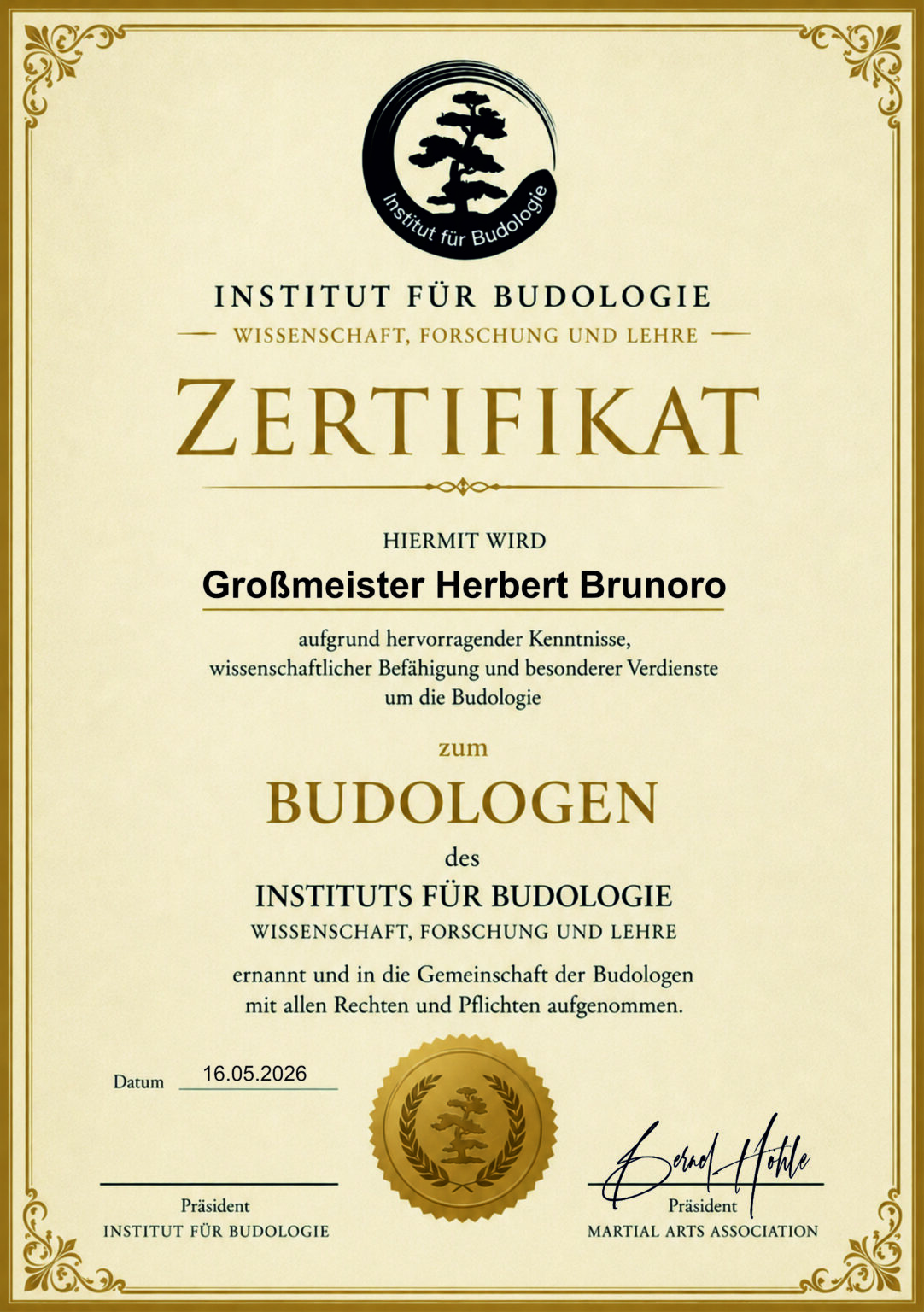
The Honorary Title “Hatamoto” in the World of Budo
The title “Hatamoto” stands in the world of Budo as a highly respected award given to exceptional personalities who have excelled in their outstanding achievements and contributions to the art and philosophy of Budo. This venerable title is given to those who are recognized as pioneers or pioneers within the Budo community. The term “Hatamoto”, literally translated as “root of the tree”, symbolizes the deep rooting and fundamental influence of the Honoured One on the art and culture of Budo.
People honored with the title “Hatamoto” are distinguished by their visionary leadership, deep commitment and inspiring presence in the Budo world. Their contributions to the development, popularization or renewal of Budo, whether through the introduction of new techniques, the overcoming of cultural and geographical boundaries or significant contributions to the theory and philosophy of Budo, have significantly shaped and preserved the art of Budo.
A Hatamoto is more than a master of his art. He is a beacon of inspiration, a mentor to future generations and a guardian of Budo’s traditions and values. Her life’s work leaves an indelible impression on Budo’s history and culture and inspires future practitioners and teachers. The title is thus a recognition of a life’s work that has left a lasting mark on and enriched the world of Budo.
The historical roots of the title “Hatamoto” date back to the feudal period of Japan, during which time “Hatamoto” referred to a person of great importance within the samurai warrior class. The title then symbolized a foundation or origin for knowledge, leadership and tradition in the martial arts community. Hatamotos were distinguished teachers or masters known not only for their skills in warfare but also for their deep understanding of the philosophical and ethical principles of Bushido.
In their role as guardians and facilitators of martial arts traditions and techniques, they had a great influence on the military and cultural development of their time, and their teachings and practices played a central role in the training of young samurai and shaped the moral and ethical values of this warrior class.
As special followers or advisors to nobles or daimyos, hatamotos were of enormous importance in feudal society, appreciated for their wisdom, honor and integrity, and embodied the heart of samurai culture.
Today, the awarding of the title “Hatamoto” honors individuals who have done significant work as teachers and guardians of martial arts traditions. The title represents not only the mastery of the martial arts, but also the role of a guardian of tradition and a leader who lives and transmits the principles and values of Budo in the modern world. The Hatamoto thus stands for the bridge between the venerable past and the living present of Budo, a symbol of the unceasing transmission of knowledge and wisdom across generations.